
Fire Damage Demolition
in Sacramento, CA
The short answer
After a house fire, you choose the demolition contractor. Not your insurance company.
California law gives property owners the right to hire whichever contractor they want, not the lowest of three forced bids. Demo Patrol clears fire-damaged property across Sacramento County, and we know the insurance side as well as the equipment side.
See your price in 60 seconds.
Real number, on screen. No phone tag.
CA Contractor #1117491 · Insured · Free walkthrough confirms final price.
The Insurance Side
You Choose the Contractor.
Not the Insurance Company
When a fire damage demolition runs through an insurance claim, the process has its own language. We write itemized estimates "specifically written in insurance lingo" so the adjuster can approve scope without three rounds of clarification. If the initial approval does not cover the full demo and debris removal, we work with the adjuster directly.
Payment usually flows the simple way. The property owner receives the claim payout, then pays us like any other project. One contract, upfront pricing, no surprises between you and your carrier. And if you are a general contractor managing the rebuild, we slot in as the demo trade and hand you a cleared pad ready for rebuild preparation.
Fire Day to Demo Day
What Happens
Before We Arrive
On fire day, the fire department removes and caps the gas meter and lines, then tapes off the structure. The structure sits until the safe-removal date is approved. That waiting period is when the paperwork moves:
- 1. Demolition permit filed: about $250 in Sacramento County, $300 and up with extra review inside the City of Sacramento
- 2. SMAQMD asbestos survey and 10-day clearance for pre-1980 structures, burned or not
- 3. Utility disconnection beyond the gas the fire department already handled
- 4. Permit coordination handled by us, start to finish
The asbestos step runs on its own clock. Our Sacramento asbestos notification guide walks through it in detail. Fire work also takes us into the foothills, covered on our Calaveras County fire damage demolition page.
Not Standard Debris
Why Fire Debris Is
Handled Differently
A burned structure is not standard demolition debris, and the crushing, loading, and debris haul-off all change because of it. Soot, smoke damage, and ash-contaminated debris call for wet handling, so we hook up to water or bring a water truck and spray the debris down while we crush. Every load leaves the site tarped and bungeed, the legal standard for hauling fire debris on California roads.
Disposal is the part nobody warns you about. Most landfills will not accept fire debris. That is hazard management as a process, not a buzzword, and it is why fire debris removal quotes deserve scrutiny. Ask any bidder where the burned material is going. We can answer with names.
-
Wet handling during crushing
Water truck or hookup on site, debris sprayed down while machines work
-
Tarped and bungeed loads
Every load secured to the legal standard for fire debris transport
-
Kiefer Landfill
Accepts Sacramento-area fire debris when most landfills will not
-
Specialized facilities
Loads needing extra handling route to a facility that accepts them, documented
Real Work
Partial Burns and Full Teardowns
We Have Cleared
Not every fire takes the whole structure. Partial demolition is common, complete building demolition happens when nothing is worth saving, and controlled demolition around what survives is a skill of its own. Every job runs backed by CA Contractor #1117491, an OSHA-10 Certified crew, and an A+ BBB Accredited record.
Sacramento
A fire-damaged garage taken down with the foundation preserved in place for the rebuild.
Ione
A double-wide mobile home destroyed by fire, cleared to bare pad.
Tracy
Burned trailers removed for FedEx, commercial fire demolition on a working logistics site.
Residential fire demolition and commercial fire demolition run through the same crew, the same structural demolition standards, and the same documentation. From East Sacramento and Land Park to Arden-Arcade and Elk Grove, the fire is different every time. The process is not. One clarification worth making: we are not a fire damage restoration company. Restoration contractors dry, clean, and rebuild what can be saved. We remove what cannot, including concrete removal where slabs are compromised, and we leave a graded site ready for whoever builds next.
Pricing
What Fire Damage Demolition
Costs in Sacramento
Honest answer: it depends on what the fire left behind. In Spencer's words, "sometimes we don't need to charge extra" beyond standard demolition rates. When conditions demand more, "10 percent or more is fair," and the drivers are specific: soil scraping, dirt testing, and how much of the structure requires hand separation before machines can work.
Standard demolition math still anchors the number. House demolition in Sacramento runs $8 to $15 per square foot, and final grading runs $3,500 per day. The fire premium, when there is one, gets itemized in writing so you and your adjuster see exactly what it covers.
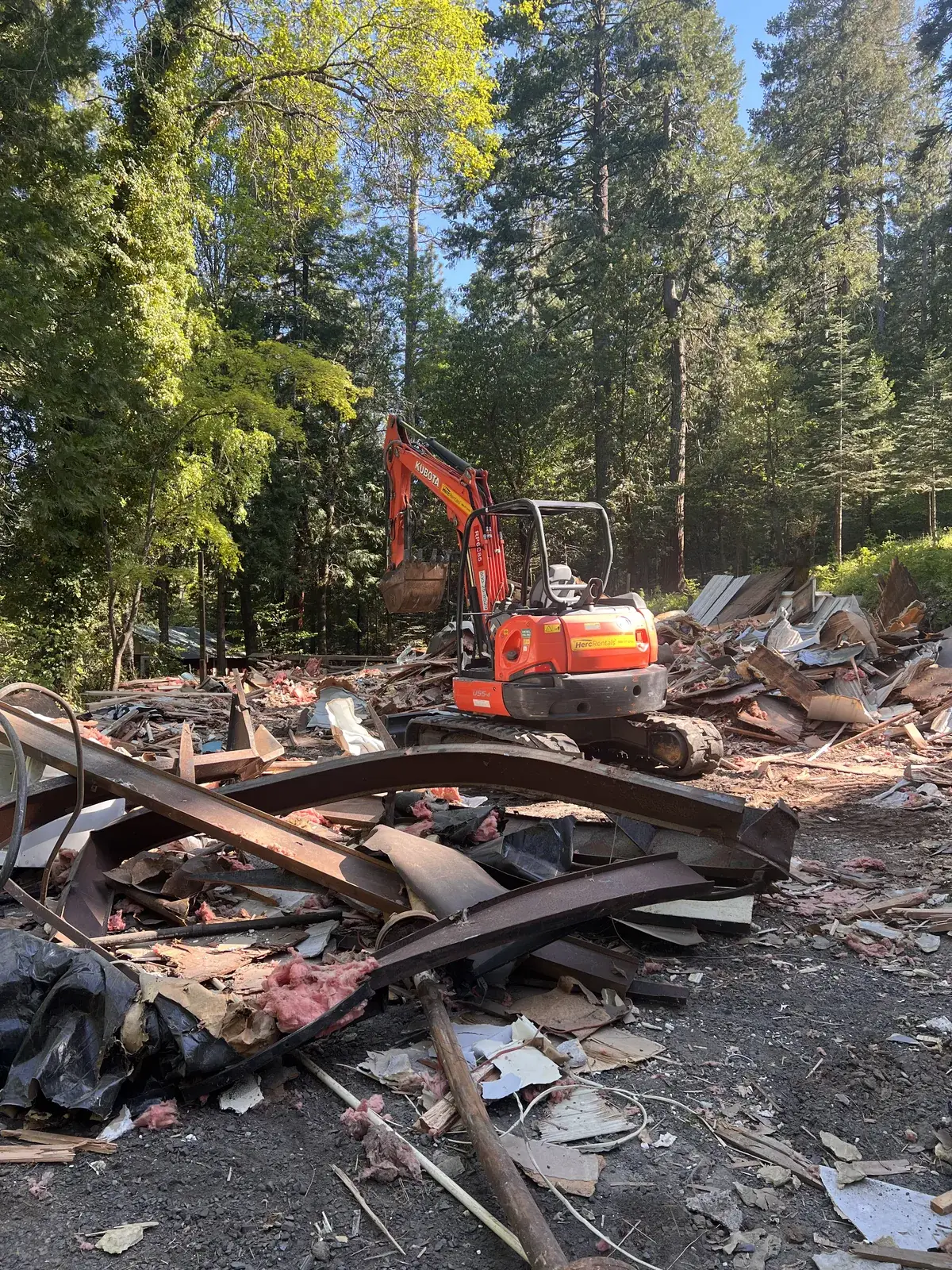
Fire demolition is where we started.
Real Demo Patrol fire-area teardown in Magalia, Butte County.
Common Questions
Fire Damage Demolition
FAQs
Does insurance pay for fire damage demolition in Sacramento?
Usually, when demolition is covered in the claim. California property owners choose their own contractor, and we provide itemized estimates written for adjusters. The typical flow: the carrier pays the owner, and the owner pays us like any standard project. Which carrier you have does not change anything on our end. We work with all of them, and you never need us to sit on a preferred vendor list to hire us.
How soon after a fire can demolition start?
After the fire department approves a safe-removal date. Permits and the SMAQMD 10-day asbestos clearance usually run during that window, so the demolition permit and the fire department timeline finish close together. We file paperwork immediately so the machines are the only thing waiting.
Where does fire debris go?
Kiefer Landfill accepts fire debris from Sacramento-area jobs. Most other landfills will not, and specialized loads route to a facility that takes them. Debris is wetted during crushing, hauled tarped and bungeed, and documented load by load.
Can you demolish only the burned part of a structure?
Yes. Partial demolition is common after fires. We have taken down a fire-damaged Sacramento garage while preserving its foundation, and controlled demolition around surviving structure is planned during the site walk before any equipment arrives.
What do I get when the job is done?
A cleared pad, final grading, and the disposal paperwork your insurance claim and your next contractor will both want. If a rebuild is coming, the site is ready for it.
Talk to us before you sign anything with your carrier.
Call (916) 909-1359. The Site Walk Is FreeMore Demolition Services in Sacramento
Every type of full structural demolition across the Sacramento area, handled by one licensed and insured crew.
Get Your Fire Damage Demolition Quote
Licensed and insured demolition contractor serving Sacramento, CA and the Greater Sacramento Region. Insurance-ready itemized estimates with a written scope in 24 hours.
Want a number before you call? See an instant price range in about a minute.